Dubai Passenger & Luggage Capacity Guide
Understand the difference between available seats and usable luggage space, from private cars and passenger vans to minibuses and coaches. Plan your group with confidence before travel.
How Many Passengers and Bags Can Fit in One Vehicle?
A passenger seat count tells you how many people a particular vehicle configuration is designed to seat; it does not tell you how many large suitcases will fit when every seat is occupied. We recommend counting passengers, checked suitcases, cabin bags and bulky items separately. We then check the actual seating layout and usable baggage space before suggesting a vehicle for your Dubai transfer or group journey.
Why We Treat Passenger and Luggage Capacity as Two Separate Questions
When you arrange group transportation in Dubai, a single number such as 12, 15, 30 or 50 seats can seem to answer the entire vehicle question. In practice, the group needs two kinds of space: a suitable seat for each passenger and secure, usable room for everything the group is carrying. We assess both. A group that travels with small day bags has a different requirement from an airport arrival carrying checked suitcases, pushchairs and sports equipment.
We use this guide to help you prepare accurate information before requesting a vehicle recommendation. The goal is not to promise a suitcase count for every model. Different seating layouts, vehicle conversions and baggage compartments can change what will fit. Our fleet overview introduces the vehicle categories; this guide explains the questions to ask when deciding between them.
If your party includes children, count everyone who needs a passenger seat. If it includes an infant seat, mobility aid, stroller or oversized item, mention that separately. The space occupied by those items can change the practical choice even when the total passenger number stays the same. We would rather discuss that before travel than discover a mismatch when your group is ready to depart.
How to Read Passenger Capacity Correctly
A capacity label is a starting point, not a packing guarantee. First identify the actual number of usable passenger seats in the specific vehicle being offered. Do not assume every version of a Toyota Hiace, Hyundai H1, Staria, Mercedes van or Sprinter has an identical arrangement. Seats, access routes, storage compartments and conversions may vary. We check the proposed vehicle rather than relying on the model name alone.
Next, distinguish a seat count from a comfortable travel plan. A passenger may carry a backpack, laptop case or handbag as well as a suitcase. The group may need space for a child seat, folded stroller or event materials. These items are not interchangeable with passenger seating. Luggage must be secured appropriately and must not obstruct doors, aisles, driver visibility or emergency access.
Finally, tell us how the group will use the vehicle. A short hotel-to-meeting transfer with no checked baggage differs from a long airport arrival, and a multi-stop itinerary differs from a direct drop-off. The vehicle must suit the complete journey, not merely the first few minutes of travel.
Understand the layout before choosing
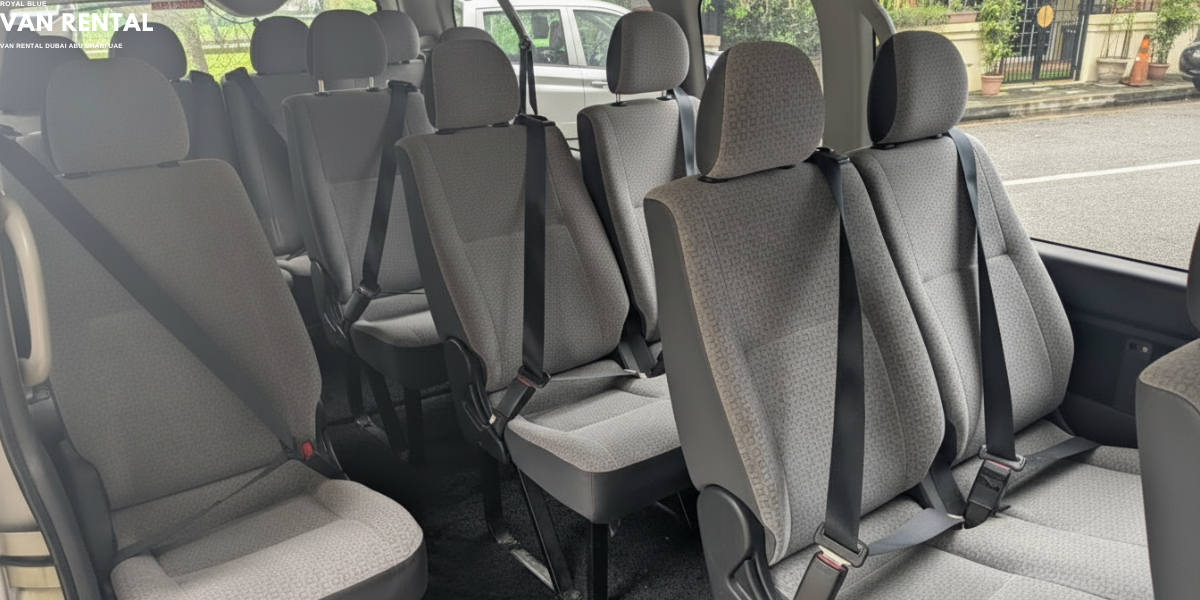
What we check before confirming
We review the number of travelers, suitcase sizes, hand baggage and any bulky items alongside the vehicle’s usable storage arrangement.
Understanding Cabin Bags, Checked Suitcases and Oversized Items
We ask customers to separate their baggage into practical groups: small personal items, cabin-size cases, medium checked suitcases, large checked suitcases and bulky equipment. Two groups with ten bags can require very different storage space. A small soft bag may fit where a rigid large case cannot; a folded stroller may have an awkward shape even when it is relatively light.
Count every item that will travel in the vehicle, including hand luggage that passengers intend to bring from the airport. It is easy to count only checked bags while forgetting backpacks, shopping bags, laptop cases and pushchairs. A realistic list is more helpful than an optimistic estimate. If you are unsure about size, approximate dimensions or photographs can help us evaluate the arrangement.
Baggage should not be stacked in a way that blocks an exit or risks falling onto passengers. Empty seats are not a substitute for approved luggage storage. When baggage volume is unusually high, we may need to discuss a larger vehicle, a different configuration or a separate luggage solution rather than simply filling the aisle.
Passenger Categories and the Luggage Question
These are vehicle category labels used in our transport planning, not verified suitcase counts or a promise that every listed configuration is available for every date.
| Vehicle category | Typical planning use | What must be checked |
|---|---|---|
| Car or MPV | Small private parties | Boot and rear-seat arrangement |
| 7–8-seat SUV / MPV | Families and small groups | Storage with rear seats occupied |
| 10–12-seat minivan | Smaller groups | Usable rear baggage area |
| 13–15-seat passenger van | Medium groups | Storage at full passenger load |
| 16–19-seat VIP Sprinter | Medium VIP groups | Specific conversion and luggage zone |
| 20–24-seat Coaster | Medium groups | Baggage configuration |
| 26–30-seat minibus | Larger groups | Dedicated luggage provision |
| 33–35-seat bus | Organized group travel | Storage layout and bag dimensions |
| 37–45-seat coach | Larger touring groups | Compartments and loading limits |
| 50–53-seat coach | Large airport groups | Actual underfloor or other storage |
| 60–65-seat staff bus | High-seat-count staff movement | Suitability for checked baggage |
Cars & MPVs: Why the Boot Matters
A car or MPV can be the right choice for a smaller party, particularly when the journey is direct and the baggage is modest. The critical question is how much luggage remains possible with the intended seats in use. Some vehicles have flexible seating, but occupying an additional row may reduce the space available behind it.
For airport journeys, tell us whether the party has one large suitcase each, a combination of cabin bags and checked bags, or bulky equipment. A small passenger count can still require a bigger vehicle if the baggage volume is unusually high. We should not assume that a vehicle with spare seats necessarily has enough safe storage for large rigid cases.
If your group includes a stroller, wheelchair or other mobility equipment, mention the folded dimensions and whether the item can be safely loaded. We can discuss the configuration before you travel. The right choice is the one that accommodates passengers and possessions together, not simply the smallest vehicle with enough seatbelts.
Small groups need a baggage plan
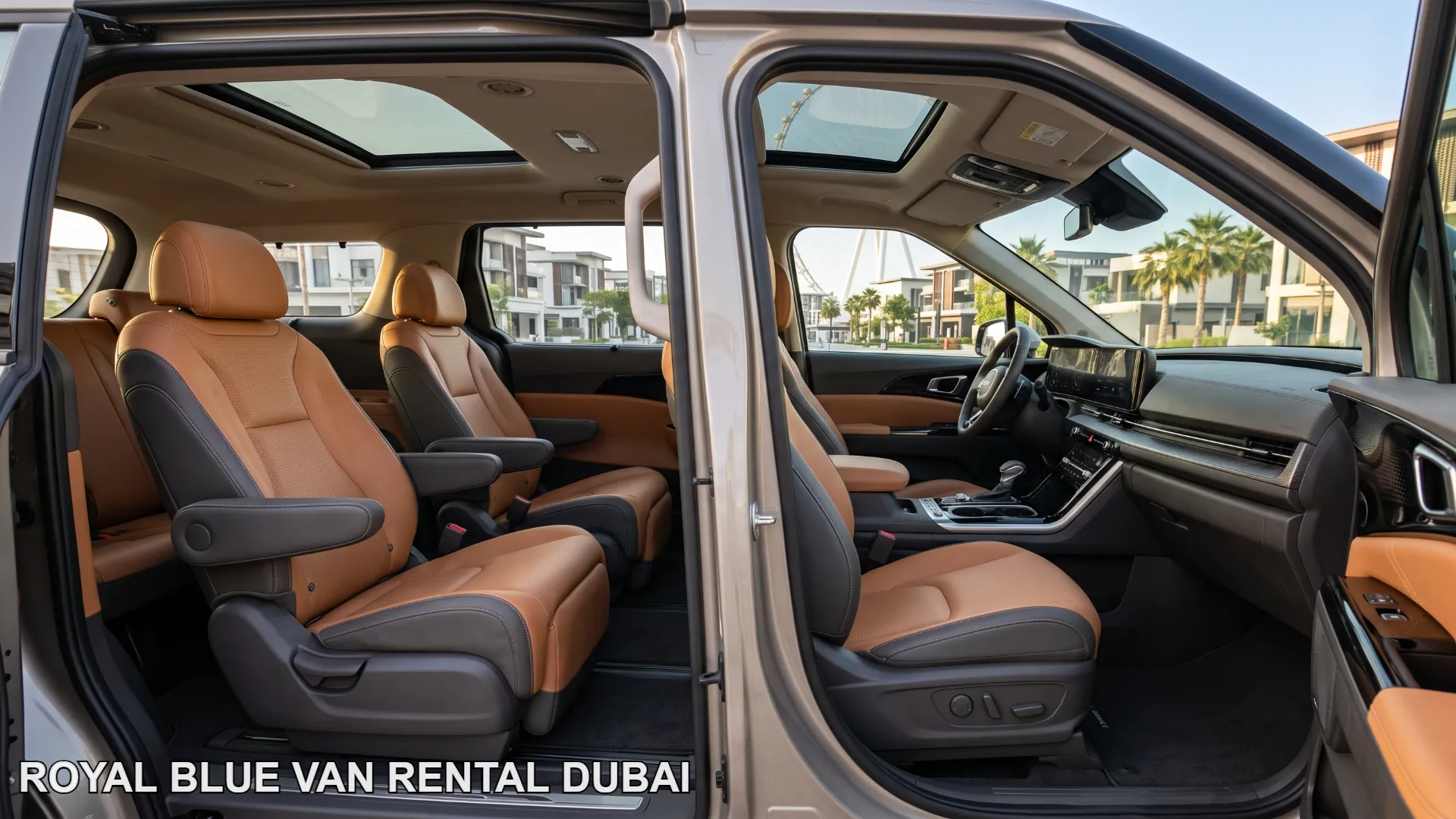
What we check before confirming
We review the number of travelers, suitcase sizes, hand baggage and any bulky items alongside the vehicle’s usable storage arrangement.
7–15 Seater Vans: The Seating and Storage Balance
Passenger vans are often considered for family airport arrivals, small tourist groups and business teams. A 10–12-seat minivan or a 13–15-seat Toyota Hiace may look roomy in a photograph, but its actual luggage capacity depends on the fitted seat arrangement and storage zone. We do not publish a universal suitcase limit for the model name alone.
The difference becomes especially important when every passenger seat is needed. Bags that seem easy to accommodate with half the seats occupied may no longer fit when the vehicle is full. A group traveling with many large cases should tell us that at the quotation stage rather than assuming the remaining rear space will be sufficient.
Our Toyota Hiace vehicle page describes that model as a service option. Here, the more useful question is whether your exact group and baggage will fit the vehicle configuration assigned to your journey. We can consider an alternative arrangement when baggage is the limiting factor.
Van seating and luggage must be assessed together
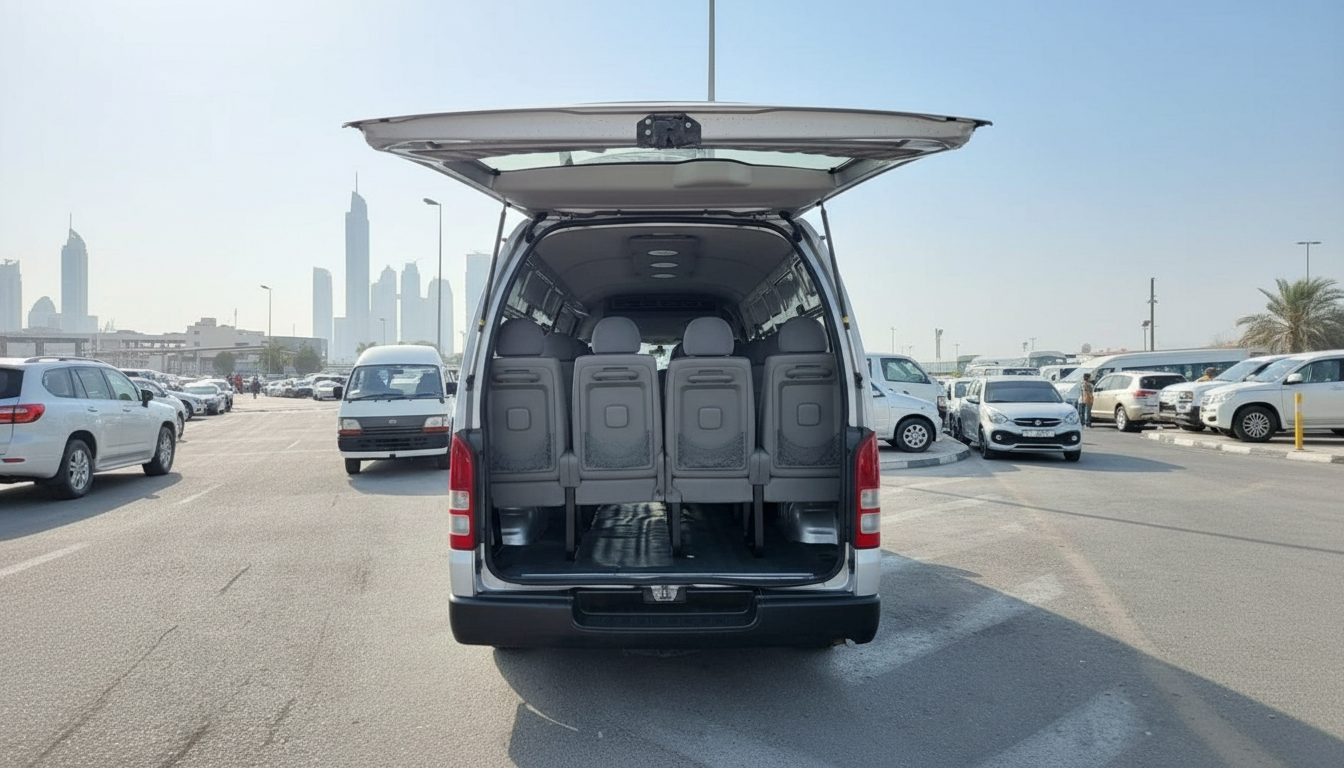
What we check before confirming
We review the number of travelers, suitcase sizes, hand baggage and any bulky items alongside the vehicle’s usable storage arrangement.
Hyundai H1, Hyundai Staria and Toyota Hiace: Different Layouts
Customers sometimes compare the Hyundai H1, Hyundai Staria and Toyota Hiace by exterior appearance or a published seat count. That is only the beginning. Seat spacing, rear storage depth, luggage access and interior configuration can all affect suitability. A photograph of an empty cabin does not prove how many checked suitcases fit behind occupied seats.
For an airport arrival, we ask for the passenger total and bag list before making a comparison. If the group has fewer people and larger bags, a different seating arrangement may be more useful than maximizing seat count. If the group has minimal baggage, the decision may be influenced more by the passenger experience and route.
You can read our individual Hyundai H1 and Hyundai Staria pages for model-specific information. This guide keeps the focus on capacity planning and the practical difference between seats and bags.
Luxury Vans & Sprinters: Confirm the Conversion
Luxury passenger vans and VIP Sprinters can have layouts designed around a different passenger experience from standard vans. Individual seats, additional legroom and other conversion choices may change how much room remains for luggage. The exterior badge does not establish a standard baggage capacity across all versions.
For executive groups, we ask whether travelers have laptop bags only or full-size checked cases. A group arriving for a conference may have display materials, samples or presentation equipment in addition to personal luggage. Those items should be included in the planning count.
A Mercedes luxury van can suit a smaller party, while a passenger Sprinter may suit a larger group, but neither statement replaces checking the actual seating and baggage layout. If the trip includes multiple hotel drop-offs, we also consider how often luggage needs to be accessed during the journey.
Check the specific Sprinter conversion
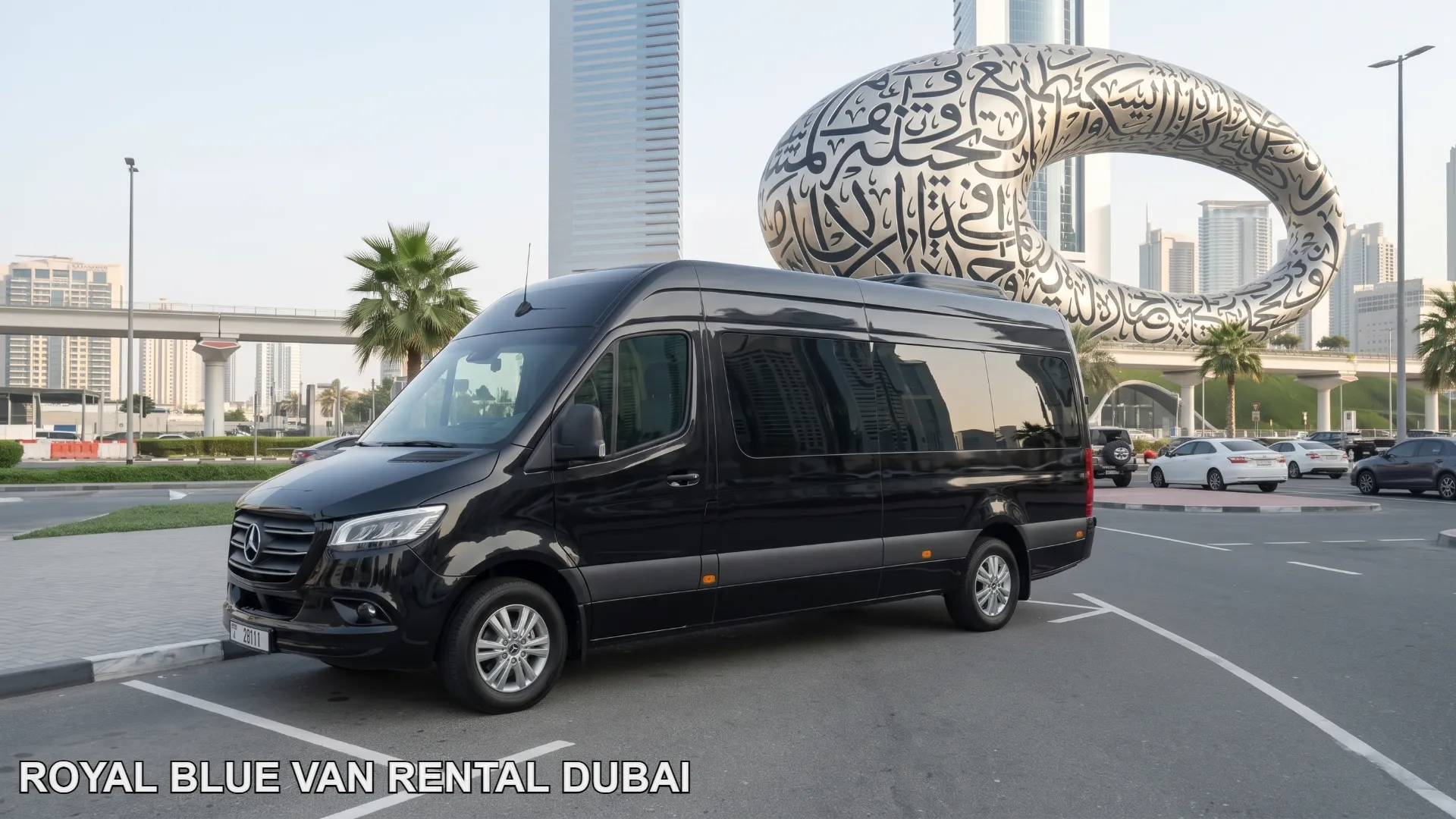
What we check before confirming
We review the number of travelers, suitcase sizes, hand baggage and any bulky items alongside the vehicle’s usable storage arrangement.
Minibuses & Coasters: Medium Group Planning
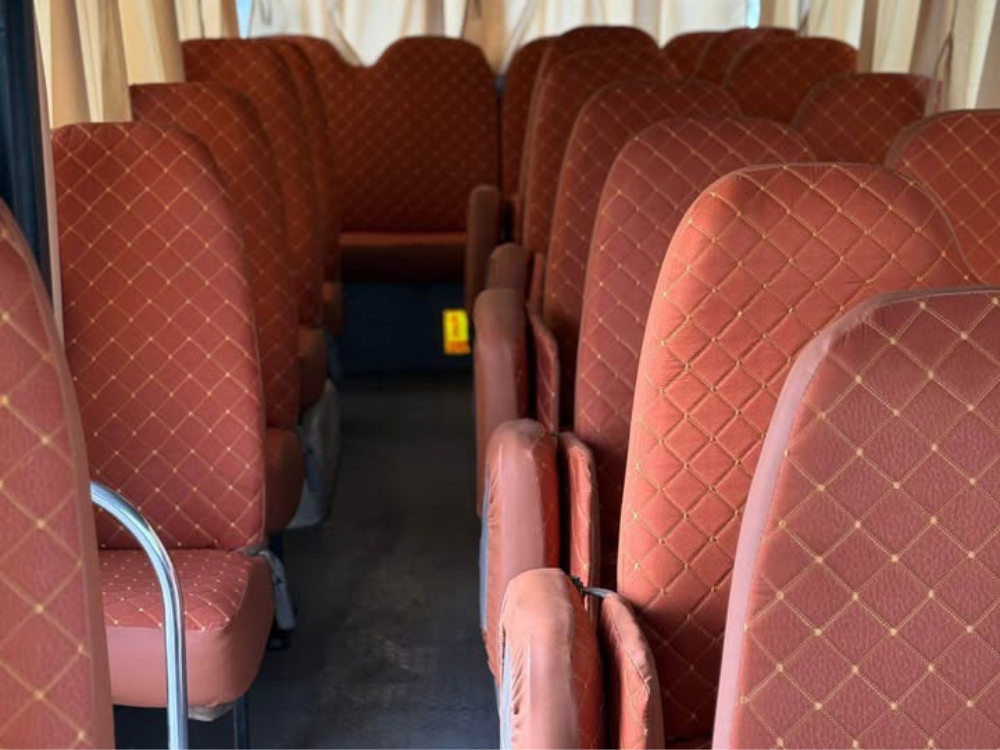
A Coaster or other minibus may be a practical option when a group is too large for a passenger van. Yet moving to a larger seat count does not automatically solve every luggage problem. Some minibuses prioritize passenger seating; others have different storage arrangements. The amount of accessible baggage space must be confirmed for the specific vehicle.
For an airport transfer, a group of twenty people with twenty checked suitcases has different requirements from twenty colleagues traveling with small backpacks. We use those details to assess whether a minibus is a sensible match or whether a vehicle with more dedicated baggage storage is preferable.
See our minibus rental Dubai page for the transport category. For this capacity guide, the essential check remains the same: every passenger needs a seat, and every bag needs a safe storage location.
Minibus capacity goes beyond seats
What we check before confirming
We review the number of travelers, suitcase sizes, hand baggage and any bulky items alongside the vehicle’s usable storage arrangement.
Buses & Coaches: Large Groups and Dedicated Storage
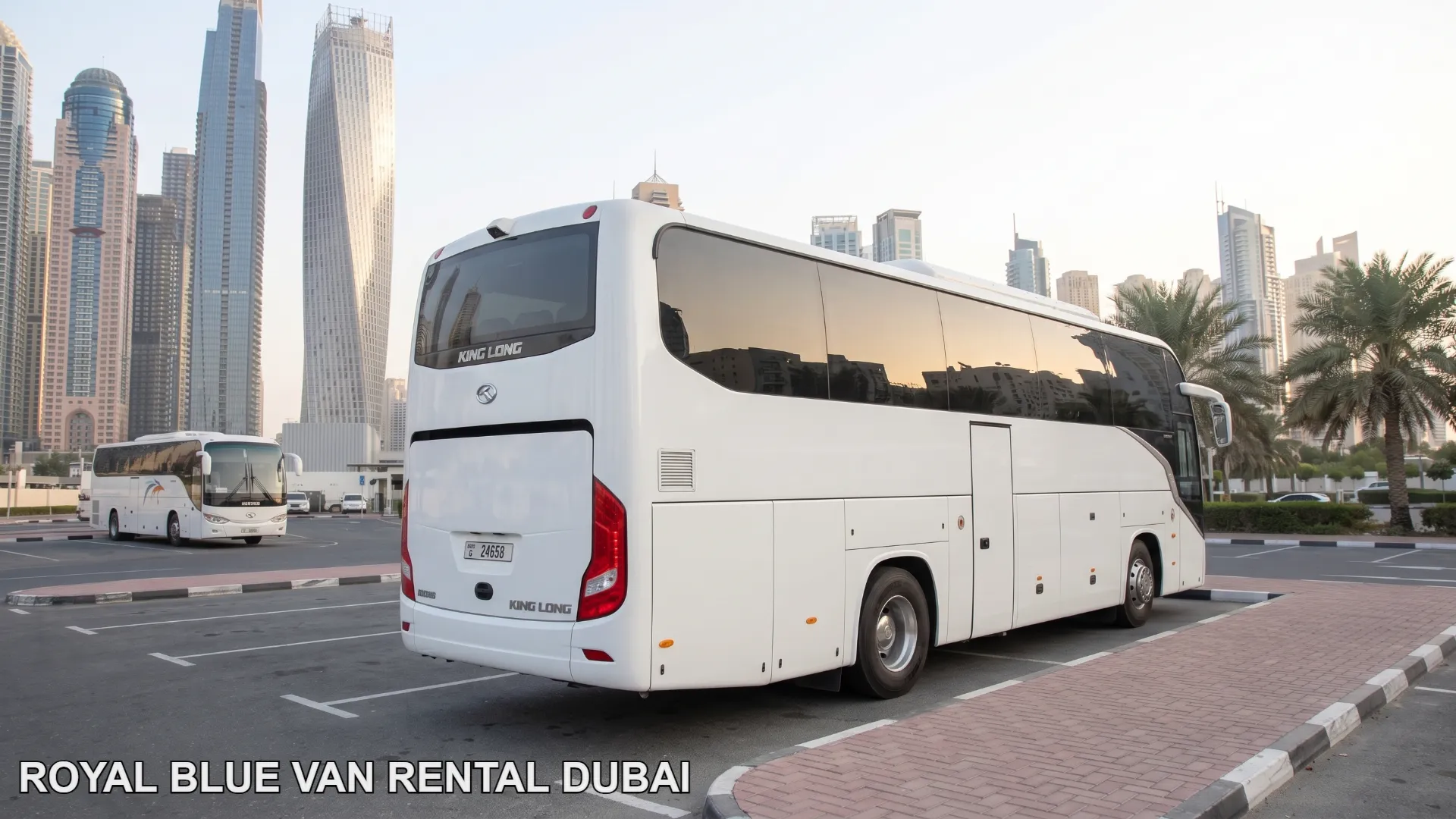
Coaches are often considered when a group travels together for airport transfers, events or longer journeys. Depending on the vehicle, luggage may be stored in dedicated compartments rather than alongside passenger seats. However, the presence of a luggage compartment does not mean it can hold unlimited cases. Compartment dimensions, loading limits and the number of large bags all matter.
A large coach with many seats may be suitable for a group carrying ordinary travel baggage, while a staff-oriented bus with a similar seat count may not be designed for the same volume of suitcases. We distinguish the purpose of the vehicle from its advertised passenger count.
Our 50-seater coach rental Dubai page covers the larger coach category. If your group includes exhibition equipment, musical instruments or unusually bulky cases, provide dimensions and quantities before the vehicle is confirmed.
Coach storage should be verified
What we check before confirming
We review the number of travelers, suitcase sizes, hand baggage and any bulky items alongside the vehicle’s usable storage arrangement.
Passenger vs Luggage Trade-Off: What Changes at Full Occupancy
The more seats a group needs, the less flexibility there may be to rearrange the cabin or use unoccupied seating areas. This is particularly noticeable in smaller passenger vehicles. The correct approach is to evaluate passenger occupancy and baggage volume at the same time, not to book based on the larger of two rough guesses.
A group of twelve people with only backpacks may have a very different best-fit vehicle from twelve people arriving with twelve large suitcases, twelve cabin bags and two strollers. The passenger count is identical, but the storage requirement is not. This is why we request a baggage breakdown instead of only asking how many people are traveling.
It is also important to consider luggage access. A direct airport-to-hotel transfer may involve loading and unloading once. A trip with several hotel stops may require bags to be retrieved in stages. The loading plan should avoid burying a first-stop suitcase under the rest of the group’s belongings.
The trade-off is about usable space
What we check before confirming
We review the number of travelers, suitcase sizes, hand baggage and any bulky items alongside the vehicle’s usable storage arrangement.
Airport Group Examples: DXB and DWC Arrivals
Dubai International Airport and Al Maktoum International Airport group arrivals can involve checked bags, cabin bags, children’s equipment and passengers arriving on different flights. We ask customers to confirm the airport, terminal where applicable, arrival details, passenger numbers and luggage list so that the vehicle and pickup plan are considered together.
Imagine eight passengers arriving with twelve large suitcases. An eight-seat vehicle might satisfy the seating requirement but still be unsuitable for the baggage. Now imagine twelve passengers with twelve large suitcases and additional hand luggage. The seat count alone does not prove that a 12-seat vehicle is the right answer. Both examples need an actual storage check.
For a larger party, such as forty passengers arriving with checked baggage, the question shifts to the coach’s dedicated storage arrangements and the dimensions of the bags. Our Dubai airport group transfer guide explains wider airport coordination; this article concentrates on matching passengers and bags to a suitable vehicle.
Plan the airport pickup around real bags

What we check before confirming
We review the number of travelers, suitcase sizes, hand baggage and any bulky items alongside the vehicle’s usable storage arrangement.
Family Travel: Strollers, Child Seats and Extra Bags
Family groups often have more items than the number of passengers suggests. A stroller, child seat, changing bag, children’s suitcase and several personal bags may accompany a relatively small family. We recommend listing these items individually, even if some can be folded or nested.
Child seating requirements must be addressed separately from baggage storage. A child seat uses a passenger position, and its suitability depends on the vehicle and seating arrangement. We should not assume that an item can be placed on a seat or in an aisle simply because it fits physically.
If you are traveling with older relatives or passengers who may find boarding difficult, mention that as well. A suitable group vehicle is not only about the total space inside; access, comfort and the ability to load luggage without obstructing passenger movement also matter.
Corporate Delegations, Events and Equipment
Corporate groups may travel with small laptop bags on one journey and substantial luggage on another. Conference delegates arriving from overseas can carry checked cases, while a local team attending a meeting may bring very little. We therefore treat the journey purpose as useful context, but we still ask for the actual number and type of bags.
Exhibition stands, sample cases, display boards and event equipment need special attention. Their shape can be more restrictive than their weight or total count. A long rigid case may not fit into the same compartment as several soft bags. We ask for approximate dimensions before confirming a vehicle arrangement.
For multi-stop schedules, consider the order in which items will be unloaded. If several teams have separate destinations, identifying which bags belong to each stop can make the journey smoother. We can plan around the itinerary when we know those details in advance.
Why We Do Not Recommend Storing Bags in Aisles
Passenger aisles, doorways and access areas must remain clear. Even when a bag can physically be squeezed into a gap, that does not make it a suitable or safe place to transport it. We focus on storage arrangements that allow passengers to board, sit and leave the vehicle appropriately.
Large cases can shift during braking or turning if they are not secured. Loose items can also make loading and unloading slower, particularly when a group is traveling with children or making several stops. We prefer a realistic vehicle selection over a plan that depends on piling bags into passenger space.
When the luggage list exceeds the suitable storage area, the next step is to reassess the vehicle category or discuss a separate baggage arrangement. We do not treat overloading as an acceptable way to keep the booking within a smaller vehicle.
When Choosing a Larger Vehicle Makes Sense
A larger vehicle can be useful when the group has more luggage than its passenger count would suggest. That does not mean bigger is always better. The goal is to find a configuration with the right seating and usable storage, taking into account access at the pickup and drop-off locations.
Before changing categories, we check whether the baggage estimate is accurate. Sometimes the group has counted the same suitcase twice; at other times, cabin bags and strollers have been forgotten. A clear inventory helps avoid both unnecessary upgrades and unsuitable bookings.
If a larger vehicle is needed, we explain the reason in terms of the actual group requirement. We can also discuss whether passengers are traveling together throughout the journey or splitting into separate groups, since that affects the usefulness of one large vehicle versus several smaller ones.
How to Calculate Your Group’s Requirements
Start with the number of adults, children and other passengers requiring seats. Then count large checked suitcases, medium cases, cabin bags, backpacks, strollers, wheelchairs and unusual equipment separately. Include approximate dimensions for oversized items. This creates a much clearer picture than a single phrase such as “normal luggage.”
Next, confirm the journey: airport and terminal if applicable, pickup and drop-off locations, number of stops, travel date and whether the whole group will remain together. If the group is arriving on different flights, explain whether everyone will travel in one transfer or in separate movements.
Finally, ask us to confirm the actual vehicle configuration against your list. The result should be a practical transport plan with seats for everyone and a safe place for the baggage, rather than an unverified assumption based on a model’s advertised capacity.
Common Passenger and Luggage Planning Mistakes
One common mistake is to count passengers accurately but estimate luggage as “one bag each.” Travelers may each have a checked suitcase, cabin case and backpack. Another is to assume a model always has the same interior layout. Both can lead to an unsuitable vehicle selection.
A second mistake is choosing a vehicle from a photograph without checking the actual configuration assigned to the booking. Pictures are helpful for understanding a vehicle category, but they do not prove the available storage dimensions on your travel date.
A third mistake is leaving out bulky items or planning to put bags in aisles. Tell us about strollers, mobility equipment, sports gear and display materials at the beginning. The more complete your information, the easier it is for us to recommend a suitable option.
Our Capacity Confirmation Process Before Your Journey
When you contact us, we begin with the number of passengers and the journey details. We then ask about checked baggage, cabin bags and special items. If the group is near the seating limit of a vehicle category or has unusually heavy luggage requirements, we give the storage question additional attention.
We compare the request with the vehicle configuration being considered and discuss any practical constraints. A comfortable seat count without sufficient baggage space is not a complete match. Equally, a vehicle with ample luggage space but too few seats is not appropriate.
You can browse our vehicle fleet and the van rental Dubai homepage for the wider range of services. For capacity planning, the most useful message you can send is a complete passenger and baggage list with your pickup and destination details.
Airport Group Scenarios: What to Check
These are hypothetical examples to illustrate the decision process; they are not suitcase-capacity promises for any Royal Blue vehicle.
| Group example | Baggage situation | Planning decision |
|---|---|---|
| 4 travelers | 4 large cases + 4 cabin bags | Check boot/storage with occupied seats |
| 8 travelers | 12 large suitcases | Seats alone do not confirm suitability |
| 12 travelers | 12 large cases + hand luggage | Check full-seat baggage area |
| 20 travelers | 20 checked cases | Confirm minibus luggage configuration |
| 40 travelers | 40 checked cases + cabin bags | Confirm coach compartment dimensions |
| Staff group | Mostly personal backpacks | Seat count may be more important than large-case storage |
Your Passenger and Luggage Checklist
Share the complete picture so we can review seating and storage together.
Total adults and children requiring seats
Large, medium and cabin-size suitcase counts
Backpacks and personal bags
Strollers, wheelchairs and bulky equipment
Airport, terminal and arrival or departure details
Pickup, destination and number of stops
Any separate flight arrivals or group movements
Approximate dimensions of unusually large items
Frequently Asked Questions
Our answers focus on planning your actual group and luggage, not assuming that every vehicle of the same model has identical storage.
How much luggage fits in a passenger van?
There is no single suitcase count that applies to every passenger van. The usable storage depends on the specific seating arrangement, baggage area and sizes of the bags. Send us your passenger and luggage totals so we can check the proposed vehicle.
Does full passenger capacity reduce luggage space?
It can. When all passenger seats are occupied, there may be less flexibility for luggage than when a group uses only part of the cabin. We check the storage available with your intended seating arrangement.
Which vehicle is best for Dubai airport groups?
The best option is the vehicle that can seat everyone and safely accommodate all checked bags, cabin bags and special items. A van may suit a smaller group, while a minibus or coach may be more practical for a larger party. We confirm the actual configuration.
What is the difference between seating capacity and luggage capacity?
Seating capacity refers to usable passenger seats in the vehicle configuration. Luggage capacity refers to the safe storage available for bags and equipment. One does not automatically determine the other.
How many suitcases fit in a 7-seater vehicle?
It depends on the exact vehicle, which seats are occupied and the size of the suitcases. A full group using rear seats may leave less storage space than a smaller group. We do not assign a universal suitcase count to the category.
Can an 8-seater carry eight passengers with luggage?
Possibly, but eight seats alone do not establish whether the group’s luggage will fit. We need the number and size of the bags and the actual vehicle layout before confirming suitability.
How much luggage can a 10–12-seater minivan carry?
The available luggage space varies by model and seating arrangement. Tell us how many passengers are traveling and how many checked and cabin bags they have; we can then review a suitable minivan configuration.
Can a Toyota Hiace carry 13–15 passengers and suitcases?
A Hiace may be configured for different passenger totals, but the amount of luggage it can safely accommodate at full occupancy needs a separate check. We cannot promise a fixed suitcase count without the specific vehicle details.
Does Hyundai H1 have luggage space behind the seats?
The usable space depends on the particular H1 configuration and how its seats are arranged. We check the vehicle offered for your journey instead of assuming every H1 has the same storage.
How does Hyundai Staria luggage space compare with Hiace?
The comparison depends on the exact Staria and Hiace passenger layouts and the bags being carried. Rather than relying on model names, we assess the occupied seats and remaining luggage areas.
Is a Mercedes luxury van suitable for airport baggage?
It can be suitable for a smaller group with an appropriate luggage load. The number of large cases, cabin bags and the specific vehicle layout determine whether it is a practical fit.
How much luggage can a VIP Mercedes Sprinter carry?
VIP Sprinters can have different passenger conversions and storage arrangements. We confirm the actual configuration and your luggage list before suggesting one for an airport or group journey.
Can a Toyota Coaster carry passengers with luggage?
A Coaster may be considered for medium-sized groups, but luggage storage depends on the vehicle configuration. We check both the seating requirement and the baggage arrangements.
Do all 30-seater minibuses have luggage compartments?
No universal compartment arrangement should be assumed from the seat count. We confirm whether the specific minibus has suitable luggage storage for the group’s bags.
Does a 35-seater bus have separate luggage storage?
That depends on the bus design and configuration. We check the actual storage area rather than assuming that all buses with the same seat count are identical.
How much luggage fits in a 50-seater coach?
It depends on the coach’s actual compartments, bag sizes and loading limits. A 50-seat label is not a guarantee of space for 50 large suitcases plus hand luggage.
Are staff buses suitable for airport luggage?
A staff bus may prioritize seating rather than checked-baggage storage. If your passengers are traveling with airport luggage, we need to check whether the specific bus is suitable or another category would be better.
Does suitcase size matter when selecting a van?
Yes. Large rigid cases occupy more space than small soft bags, and unusual shapes can be difficult to store. A count without approximate sizes may not give us enough information.
Should cabin bags be included in the luggage count?
Yes. Include cabin cases, backpacks, laptop bags and other personal items, especially when each passenger has more than one bag. This helps us assess the complete load.
Can strollers and wheelchairs affect vehicle choice?
Yes. Folded dimensions, weight and passenger access requirements may affect which vehicle is suitable. Tell us about mobility equipment or strollers before the booking is confirmed.
Can luggage be placed on empty passenger seats?
Do not plan on using passenger seats or aisles as unsecured luggage storage. We assess suitable storage arrangements that keep passenger access and exits clear.
Is it better to book a larger vehicle for extra bags?
Sometimes. A larger vehicle or different configuration can provide more suitable storage, but we first check the actual bag list and the proposed vehicle. Bigger is not automatically necessary for every group.
How should we count luggage for a family airport transfer?
Count each checked suitcase and cabin bag, then add strollers, child seats, changing bags and any oversized items. Include the number of children needing seats as well.
Which vehicle is best for a group with 10 large suitcases?
That depends on how many people are traveling and whether they also have cabin bags or bulky items. We need the full passenger and luggage count before identifying a suitable vehicle.
Can 15 passengers travel with 15 large suitcases in one van?
Do not assume so based on a 15-seat description. We must check whether the actual vehicle has suitable luggage storage with all 15 passenger seats occupied.
How do we plan luggage for a corporate delegation?
Count personal bags and any laptops, presentation materials or display equipment. Share the itinerary and drop-off sequence so the loading plan can be considered along with the seating.
Do airport arrival and departure trips need different planning?
Both require accurate passenger and baggage counts. Arrivals may involve bags collected from several flights, while departures may require coordinated hotel pickups. We consider the specific journey and group arrangements.
Can sports equipment fit in a passenger minibus?
It depends on the item dimensions and the available storage in the proposed minibus. Tell us about skis, golf bags, bicycles or other oversized equipment before confirming a vehicle.
Can a group carry exhibition materials in a coach?
Potentially, but the materials must fit the coach’s suitable storage spaces and loading limits. Provide quantities and dimensions so we can check the arrangement.
Do different vehicle conversions have different storage space?
Yes. Different seating and interior conversions can change usable luggage space. We assess the actual vehicle configuration rather than making a promise based on a model badge.
How can we compare two vehicles with the same seat count?
Compare the usable seating layout, luggage storage area, access, passenger needs and the complete journey. Two vehicles with the same number of seats may have different baggage arrangements.
What should we do if our luggage exceeds the vehicle’s storage?
Tell us before travel. We can review a different vehicle configuration, a larger category or another appropriate luggage arrangement instead of relying on unsafe loading.
Can we request vehicle interior and luggage photos?
You can ask us for available photographs of the proposed configuration. Photos are useful for context, although we still need to confirm your actual luggage dimensions and counts.
What details should we send for a capacity recommendation?
Send the number of passengers, large and medium suitcases, cabin bags, strollers or bulky equipment, travel date, pickup and drop-off locations and any multiple stops.
How can we avoid booking a vehicle that is too small?
Provide a complete passenger and baggage list and ask us to confirm both the usable seats and suitable luggage space in the specific vehicle before finalizing the arrangement.
Related Vehicle and Airport Planning Guides
If you want to compare vehicle categories, start with our Royal Blue fleet. For medium groups, see minibus rental Dubai. For larger parties, the 50-seater coach guide introduces that transport option. Each page serves a different purpose from this luggage-capacity reference.
For an arrival or departure involving multiple flights, terminals or hotel stops, our Dubai airport group transfer guide covers the wider planning process. If you are comparing specific passenger van models, our Hiace, H1 and Staria comparison explains how to think about those alternatives.
When you are ready to discuss your group, send us the complete passenger and baggage list. We will use it to consider an appropriate vehicle configuration for the journey rather than relying on the advertised seat count alone.
Tell Us How Many People and Bags Are Traveling
Share your passenger count, suitcase sizes, special equipment and Dubai pickup details. We will review the seating and luggage requirements together so you can choose a practical vehicle for your journey.